- Many HME teams spend more time organizing documentation and identifying missing information than actually processing orders, making intake automation one of the highest impact opportunities for improvement.
- The biggest ROI from AI often comes from reducing rework, denials and administrative friction rather than replacing employees.
- Providers are using AI to identify referral sources that create delays and uncover opportunities to improve order quality and turnaround times.
- Organizations see the greatest results when they redesign workflows around automation instead of simply adding AI to existing processes.
- The next competitive advantage in HME will be the ability to scale operations and grow revenue without adding proportional staffing.
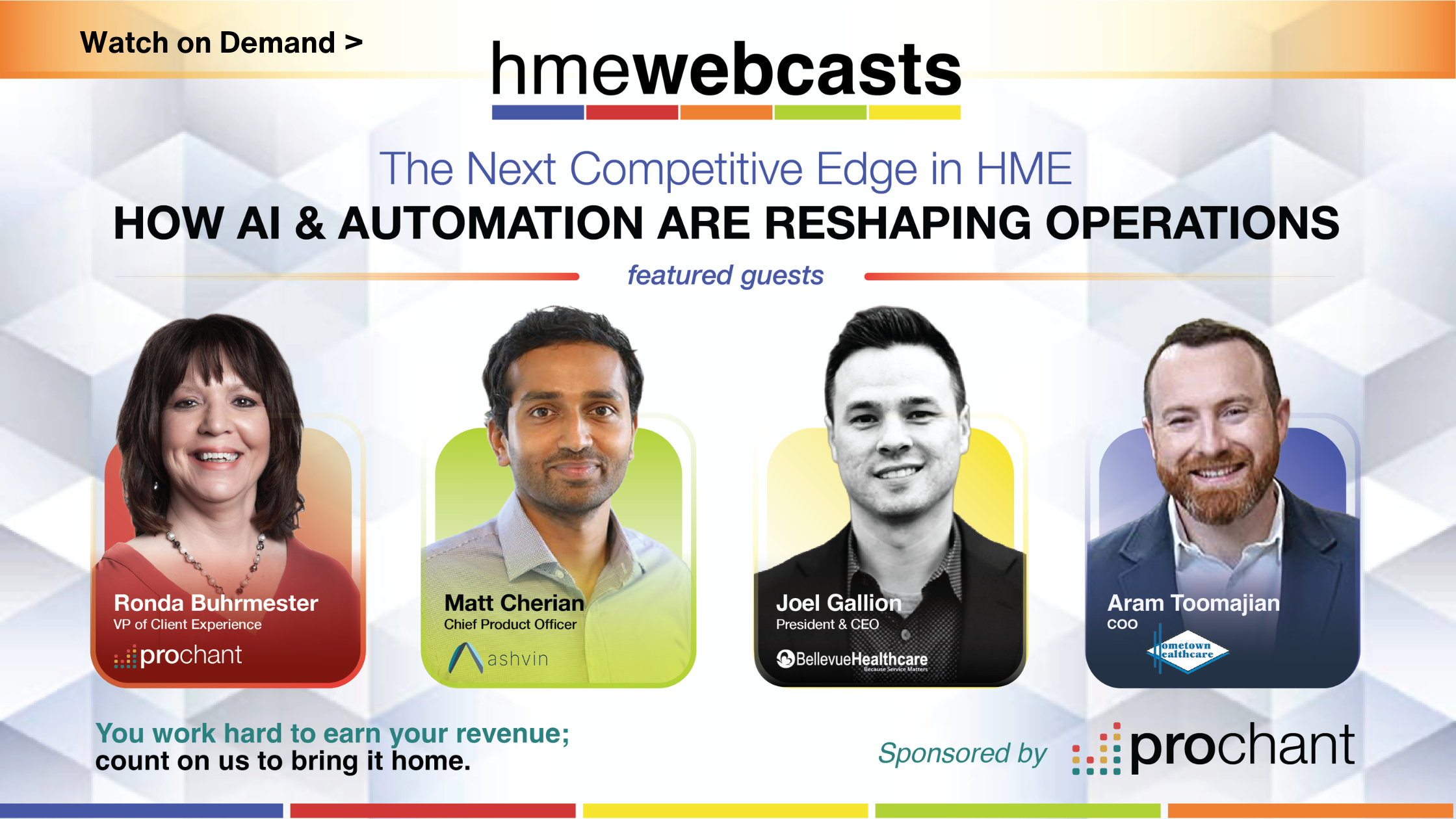
As operational pressures continue to grow across the HME industry, providers are looking for new ways to improve efficiency, reduce administrative burden and scale without sacrificing patient care. During HME News' recent webinar, “The Next Competitive Edge in HME: How AI and Automation Are Reshaping Operations,” industry leaders discussed how AI and automation are helping providers navigate today's challenges while preparing for the future.
Moderated by Prochant's VP of Client Experience, Roonda Buhrmester, the panel featured Joel Gallion, President & CEO of Bellevue Healthcare, Aram Toomajian, COO of Hometown Healthcare and Matt Cherian, Co-Founder and Chief Product Officer of Ashvin AI.
The Pressure on Traditional HME Operations
The panel opened by discussing the growing complexity of HME operations. Staffing shortages, documentation requirements, reimbursement challenges, disconnected systems and rising patient expectations are all putting pressure on traditional workflows.
Many providers are still managing processes across multiple platforms and relying heavily on manual tasks, creating inefficiencies that impact both employees and patients. As operational complexity increases, providers are seeking ways to streamline workflows and improve visibility across their organizations.
Where AI Is Delivering Real Results
While AI continues to generate significant attention, the panel emphasized that the greatest value comes from applying technology to specific operational challenges.
Areas where providers are seeing meaningful impact include:
- Improved visibility into orders, referrals and workflow bottlenecks
- Smarter routing of documentation and tasks
- Reduced manual work and documentation rework
- Increased scalability without adding proportional staffing
One recurring theme was that successful AI adoption is not about layering technology onto existing processes. Instead, organizations are seeing the best results when they rethink workflows and use automation to eliminate friction throughout the process.
AI Supports People. It Does Not Replace Them.
The discussion also highlighted the critical role people continue to play in HME operations.
Relationships with patients and referral partners remain essential, as do the expertise and judgment required for complex cases. Rather than replacing employees, panelists shared how automation is helping teams focus on higher-value work by reducing time spent on repetitive administrative tasks.
What HME Leaders Should Watch Next
Looking ahead, the panel expects continued growth in areas such as intake automation, clinical documentation review, workflow orchestration and prior authorization support. Longer term, advancements like real time claims adjudication and more connected operational ecosystems could significantly reduce friction across the patient journey.
One key message emerged throughout the discussion: providers do not need to have all the answers today, but they do need to start experimenting. Organizations that begin building AI capabilities now will be better positioned to adapt as technology continues to evolve.
Watch the Full Webinar On Demand
See how HME leaders are using AI and automation to improve efficiency, reduce administrative burden and scale operations.
Frequently Asked Questions
What was the HME News webinar about?
The webinar, “The Next Competitive Edge in HME: How AI and Automation Are Reshaping Operations,” focused on how AI and automation are helping HME providers improve efficiency, reduce administrative burden and prepare for future operational challenges.
How is AI changing HME operations?
AI is helping HME providers improve visibility into orders, referrals and workflow bottlenecks, route documentation and tasks more efficiently, reduce manual work and support greater scalability without adding proportional staffing.
Why is intake automation important for HME providers?
Intake automation is important because many HME teams spend significant time organizing documentation and identifying missing information before orders can be processed. Automating parts of intake can reduce rework, improve order quality and accelerate turnaround times.
Does AI replace employees in HME organizations?
No. The webinar emphasized that AI supports people rather than replacing them. Automation helps reduce repetitive administrative work so employees can focus on higher-value tasks, complex cases and relationships with patients and referral partners.
What should HME leaders do to prepare for AI and automation?
HME leaders should begin experimenting with AI, identify workflow bottlenecks, evaluate where automation can reduce friction and redesign processes around automation rather than simply adding technology to existing workflows.
Frequently Asked Questions
What is Prochant PulseIQ™?
Prochant PulseIQ™ is Prochant’s suite of AI-driven revenue cycle management tools designed to help home-based care providers improve intake, billing, collections and reimbursement visibility across the revenue cycle.
How does AI impact reimbursement workflows in home-based care?
AI is increasingly being used by payers to automate claims review, evaluate documentation requirements, apply payer-specific rules and identify potential reimbursement issues earlier in the process.
What does IntakeIQ help providers improve?
IntakeIQ helps providers identify missing documentation requirements and uncover potential reimbursement issues before services begin, helping create a stronger front-end foundation for revenue cycle performance.
How does BillingIQ support cleaner claims?
BillingIQ helps providers improve claim quality before submission by identifying documentation gaps and payer-specific requirements ahead of time, helping reduce avoidable denials and support cleaner claims from the start.
How does CollectionIQ improve collections and denial management?
CollectionIQ helps revenue cycle teams prioritize denials and outstanding accounts based on likely financial impact, enabling a more strategic approach to collections and revenue recovery.
How can home-based care providers prepare for an AI-driven reimbursement landscape?
Home-based care providers can prepare by improving documentation accuracy, strengthening intake and billing workflows, increasing visibility into denial trends and adopting technology that helps identify reimbursement risks earlier in the revenue cycle.
Why is revenue cycle intelligence important in modern healthcare reimbursement?
Revenue cycle intelligence helps providers identify reimbursement risks before they affect cash flow. As payer workflows become more automated, providers need greater visibility into documentation gaps, denial trends and operational inefficiencies to maintain strong financial performance.
How does AI help reduce healthcare claim denials?
AI helps reduce healthcare claim denials by identifying missing documentation, payer-specific requirements and potential claim issues before submission. This supports cleaner claims, improved first-pass acceptance rates and fewer avoidable denials.
What should providers look for in an AI-driven RCM partner?
Providers should look for a revenue cycle management partner that combines AI-driven tools with experienced RCM specialists, offers visibility into reimbursement performance and supports proactive workflows across intake, billing, collections and denial management.
How does Prochant help home-based care providers improve reimbursement outcomes?
Prochant combines expert revenue cycle teams with AI-driven tools and analytics technology through Prochant PulseIQ™. This approach helps providers strengthen intake, improve claim quality, prioritize collections strategically and navigate today’s increasingly automated reimbursement environment.